 Students in the Master of Arts Program's Business and Economics Concentration are experienced journalists who want to develop a deep understanding of the forces driving the global marketplace and the interconnected decisions that determine how we live and whether we prosper. Developing skills to unmask false promises, they aim to expose the fault lines in the global economy, the national economy, the financial markets, the corporate world and the individual household. They can test whether a worker’s experience is singular or indicative of something much broader. Critical thinking and historical context will be emphasized, with assignments geared toward weaving analysis and key data points into writing of all forms, from news to features to investigative endeavors. Working with core faculty member Winnie O'Kelley, Business and Economics Concentration students sharpen their abilities to discern the economic ripples that ultimately dictate everyday life, and assess the true values of enterprises.
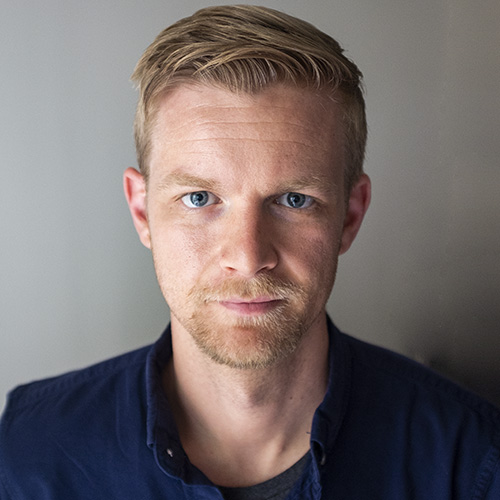
What is it like to be a member of the Business and Economics Concentration seminar? We talked about the student experience with Dominick Reuter, a 2019 graduate of the M.A. Business and Economics Concentration who is now a Senior Reporter at Business Insider, where he covers entrepreneurs and small businesses with its Strategy team, primarily for BI's Premium subscription service.
What led you to apply to Columbia's Master of Arts Program?
The reason that I started thinking about coming back to school was that I had reached a creative and professional plateau that was very difficult to get beyond. I had been a freelancer for about 10 years and had been quite successful in photojournalism. I think I could have kept pushing that forward, but what I started to feel as a photojournalist was that additional effort was not going to yield the kind of progress that I really wanted. I was looking for a supercharging boost to my career pivot. I knew I would have to stop working and earning and progressing - even if incrementally - in order to regroup and go back to school. So, any program that was going to meet that bar was going to need to be really profoundly strong. Two things made Columbia's M.A. program stand out to me: the school's national and international reputation and network, and the acceleration of the program - the fact that it's really done in nine months makes it something that's much more manageable than a year-and-a-half or two-year program. That accelerated approach - as challenging as it is - I saw as a benefit to getting my career pivot done in a timely fashion.
Why did you choose the M.A. Business and Economics Concentration?
One of the things that is really hard to teach yourself is economics - and, by extension, it's hard to teach yourself business. I thought of myself coming into the program as an economics journalist. I had covered various economic stories and the economic angle of things always made me excited. The question of how our society allocates its resources is to me a very important one. I think there's a lack of public literacy about the real measures of how we have allocated our resources collectively. I will say I came in with a bunch of assumptions about how the economy worked. The M.A. program has helped me reframe a lot of those assumptions and put a bunch of them to rest, because they were not based off of facts and really were just a bias that I had dressed up with numbers. While my heart has the same motivation, I now have a more rigorous and fact-based perspective on what the big issues are.
The biggest actors in the economy are governments and businesses. You can't learn about economics without taking a good hard look at businesses. I am on board with the business component of this degree - but it was the economics aspect that got me really keen on coming here. I initially thought about doing an M.A. in economics, but I found that this program takes a much more wholistic approach, giving you the tools that you need to interrogate economic issues as opposed to learning everything about one specific issue.
What was it like studying with Professor Winnie O'Kelley in the M.A. Business and Economics seminar?
I have nothing but the highest regard for Winnie O'Kelley. Her experience and her command of not just journalism, but the topics that we cover, was impressive. I think, on top of that, I have found a tremendous advantage in having an editor teach you these things -- writers tend to show you how they did it, whereas a good editor uncovers and cultivates what works best for you as an individual. They'll set their expectations, and they will guide you in a direction, but they give you more agency in that situation. It's a more individualized growth process.
Professor O'Kelley has a very clear set of targets that she wants us to gain a command of, and she scaffolded that instruction very carefully throughout the fall and spring. She sees how certain items feed into other items - whether it goes from the global economy to currencies, which get discussed in terms of the unemployment rate, jobs, and productivity, all the way down to debt and equity, and so it builds all the way forward. We're not learning anything without a really solid platform of fundamental prior information. You can't really discuss bonds without understanding how currencies work, you can't understand how currencies work without understanding how monetary and fiscal policies work, and you can't understand how equities until you understand what bonds are. You have to have a layered approach.
My feeling is that Professor O'Kelley had come up a curriculum with on her own which reflects what a bunch of experts at Bloomberg use to teach financial experts about how to deal with economic and business issues. She knows a lot, and she knows what she doesn't know, so she routinely called in some remarkable people to talk to us during the semesters. One day of the week, she'd give us the run-down of a concept and then on the second class of the week, she'd bring in an expert who could give us a really clear application of that concept in journalism or in the professional business world. She makes a great effort at getting people from diverse backgrounds talking about issues. Women are underrepresented in the business and economics community- they are absolutely present, but not as often tapped for their voices and opinions. Winnie made it a strong point to get women in the discussion and people from commercial and journalism backgrounds.
_______
Please click here to begin an application to Columbia for the 2021-22 academic year.
As you consider the possibility of furthering your career as a journalist at Columbia, please explore our website to learn more about Columbia Journalism School's faculty members, course offerings, and career development services.
At Columbia, a top-tier journalism education can be within financial reach. Please visit our website to learn about our scholarship opportunities.
If you would like to make an appointment to speak with an admissions counselor, please email us at apply.journalism@columbia.edu.