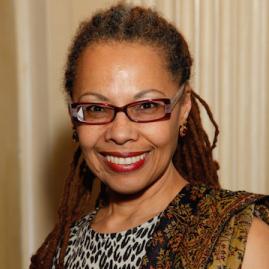
 In the run-up to the 2020 U.S. election, June Cross, the Fred W. Friendly Professor of Media and Society at Columbia Journalism School and director of the Master of Science Program's Documentary Specialization, recently directed the FRONTLINE PBS voting rights documentary "Whose Vote Counts."
The documentary, which can be viewed in its entirety here, follows correspondent Jelani Cobb, Columbia Journalism School's Ira A. Lipman Professor of Journalism, to Wisconsin to report on allegations of voter disenfranchisement and on the rhetoric and realities around mail-in ballots. The film explores how unfounded claims of extensive voter fraud entered the political mainstream, and how the pandemic could impact voter turnout. Drawing on analysis conducted by Columbia Journalism Investigations and USA TODAY NETWORK reporters, "Whose Vote Counts" places the 2020 election within the context of America’s history around voting rights and suppression, and discovers lessons for the country as a whole.
As the director of the Master of Science Program's Documentary Specialization, Professor Cross works with Columbia Journalism School students to produce documentary films that are built on on the rigorous, open-minded reporting that is evident in "Whose Vote Counts." "In the Columbia Graduate School of Journalism, there is no right answer," she explained. "You have to go out and prove to me that your thesis is correct. And I'm going to challenge you on whether it's correct, and I'm going to want you to report against your own thesis. I just finished a film on voter suppression, and I spent easily half of my time talking to people who think there is a serious problem with voter fraud in this country. I learned about the history of where they came from. I wanted to understand how they arrived at the conclusions that they've arrived at. If I don't understand that, I can't tell the story that explains why this issue is so important."
In the M.S. Documentary Specialization, Professor Cross and her faculty colleagues provide students with world‐class training in reporting and in the craft of long-form visual storytelling. "The program is the only way to do intensive long-form visual journalism and get training in the business and legal sides of documentary," Professor Cross said. "It is the way to get a foundation in how to do independent documentaries." Documentary Specialization students spend the first two semesters of the three-semester program learning how to develop sources; find and verify information; use data and develop visual skills. They learn camera work, sound recording and editing. They also learn the business side of documentary production – grant writing, negotiations, rights and clearances and how to develop a winning production trailer. The third semester – completed during the summer – allows the students to produce and edit their master’s project film. Documentary students generally work in teams and get individual coaching from advisers who are recognized documentary producers. The resulting films are screened at Columbia Journalism School's annual DocFest and are often later published: online, on cable or on broadcast.
Professor Cross's career has highlighted stories of the dispossessed and the importance of community through video documentary. She recently directed and produced the Emmy-nominated “Wilhemina's War,” about Wilhemina Dixon, an uneducated daughter of sharecroppers who became a force in her family’s fight for survival from HIV and AIDS. The film premiered at DOC NYC, screened at the Pan African Film Festival, and aired on PBS' Independent Lens in 2016.
During her career, Professor Cross has worked for FRONTLINE PBS, CBS News, and PBS’s MacNeil/Lehrer NewsHour. Her reporting for NewsHour on the U.S. invasion of Grenada won the 1983 Emmy for "Outstanding Coverage of a Single Breaking News Story." She is best known for “Secret Daughter,” an autobiographical film that examines how race and color impacted her family; it won an Emmy in 1997 and was honored that same year with a duPont-Columbia Award for Excellence in Broadcast Journalism. Her memoir, Secret Daughter, was published by Viking in 2006. Professor Cross was also an executive producer for “This Far by Faith,” a six-hour series on the African-American religious experience, that was broadcast on PBS in 2003.
___________________________________________________
Please click here to begin an application to Columbia for the 2021-22 academic year.
Please click here to register for Columbia's Fall 2020 virtual admissions events.
As you consider the possibility of furthering your career as a journalist at Columbia, please explore our website to learn more about Columbia Journalism School's faculty members, course offerings, and career development services.
At Columbia, a top-tier journalism education can be within financial reach. Please visit our website to learn about our scholarship opportunities.
If you would like to make an appointment to speak with an admissions counselor, please email us at apply.journalism@columbia.edu.